Graph Database White Papers
Neo4j
- 3 minutes read - 534 wordsGraph databases let you model data the way you actually think about it: as connected entities with relationships, not rows in a table. If your project involves networks, hierarchies, or any question where “how are these things connected?” matters more than “what are the individual fields?”, a graph database is worth exploring.
What Is a Graph Database and How Might It Be Used?
A graph database stores data as nodes, relationships, and properties instead of in tables or documents. This means you can organize your data in a similar way to sketching ideas on a whiteboard.
And since graph databases are not restricted to a pre-defined model, you can take more flexible approaches and strategies when working with them.
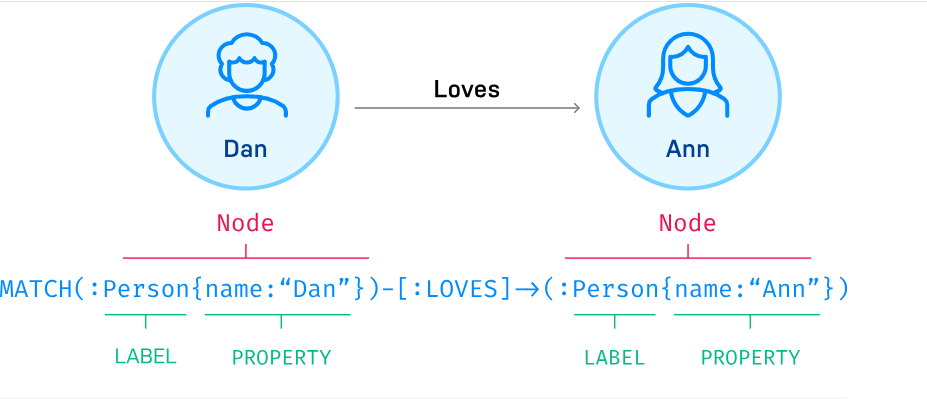
Figure 1. A visual way of matching patterns and relationships using Cypher
How It Works
Graph databases are structured through nodes and relationships.
Nodes are entities in the graph which can:
- Be tagged with labels representing their different roles in a domain (e.g., ==Person==).
- Hold any number of key-value pairs as properties (e.g., ==name==).
- Be indexed and bound by constraints.
Relationships provide named connections between two nodes (e.g., Person - ==LOVES== - Person) and they:
- Must always have a start node, an end node, and exactly one type.
- Must have a direction.
- Can have properties, like nodes.
- Nodes can have multiple relationships of various types without sacrificing performance.
In summary, nodes and relationships are an efficient and flexible way to store data since they allow you to:
- Create traversals in big graphs for both depth and breadth.
- Scale up your database to billions of nodes.
- Design flexible property graph data models that can adapt over time.
Why Use a Graph Database
Projects often deal with large amounts of complex data, and graph databases can be a powerful tool for that.
There are other ways to store data as objects and connections, such as relational databases. However, relational databases rely on computationally expensive ==JOIN== operations or cross-lookups, which are often tied to a rigid data model.
Graph databases do not use JOINs. Rather, relationships are stored natively alongside the data elements (nodes) in a more flexible format, which allows the optimization of data traversal and millions of connections to be accessed per second.
Moreover, many daily challenges and tasks can be viewed from a graph perspective, which allows you to:
- Navigate deep hierarchies.
- Find hidden connections between distant items.
- Discover inter-relationships between items.
Where Graphs Apply
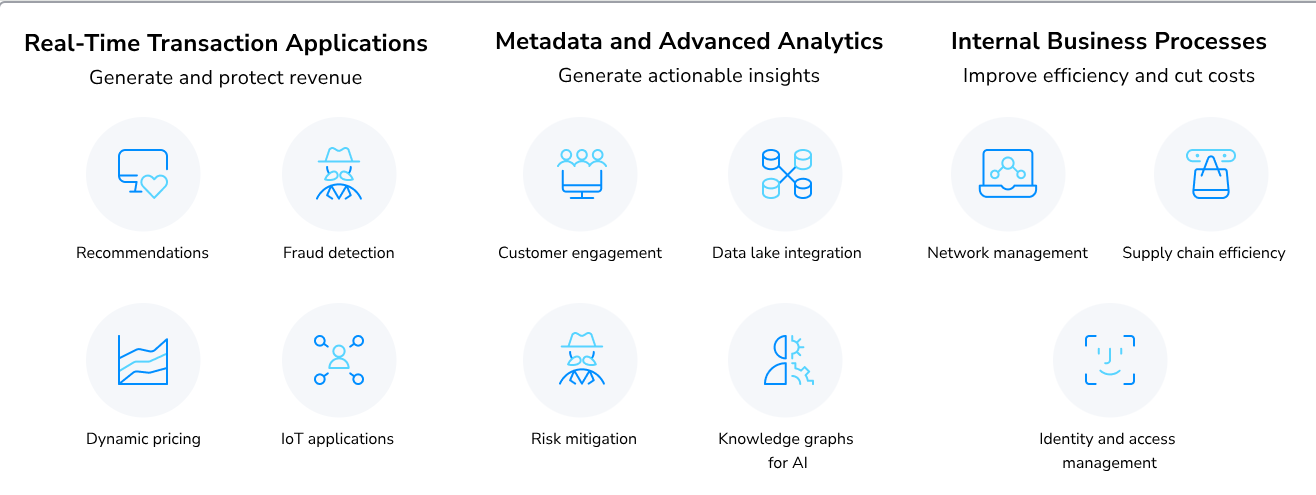
Whether it is a social network or a road network, all networks can be structured as an interconnected graph of relationships. Many times, a project’s questions and challenges revolve around the relationship between elements, not the elements themselves (e.g., how to get from A to B, instead of what A is and what B is). For this reason, graphs can be applied to many areas of society and to a wide variety of projects.
Query Language
Graph databases use a new open standard known as Cypher. Cypher is similar to and based on SQL language models, but it follows a language design that is more like spoken language while also using ASCII art.
Open Cypher Standard
Neo4j Cypher Cheat Sheet
https://neo4j.com/docs/cypher-cheat-sheet/current/
References
- Neo4j Getting Started: Graph Database (accessed 4/14/2025)